Representative Charles Luken
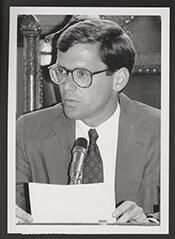
Here you will find contact information for Representative Charles Luken, including email address, phone number, and mailing address.
| Name | Charles Luken |
| Position | Representative |
| State | Ohio |
| District | 1 |
| Party | Democratic |
| Status | Former Representative |
| Term Start | January 3, 1991 |
| Term End | January 3, 1993 |
| Terms Served | 1 |
| Born | July 18, 1951 |
| Gender | Male |
| Bioguide ID | L000507 |
Editorial and Source Notes
Last reviewed: February 17, 2026
We prioritize official government pages and published records. Information can change after publication.
Primary records and source links are added as they are verified.
Report a correction: see our Editorial Policy.
About Representative Charles Luken
Charles John Luken (born July 18, 1951) is an American politician and attorney of the Democratic Party who served as mayor of Cincinnati, Ohio, and as a Representative from Ohio in the United States Congress from 1991 to 1993. He represented Ohio’s 1st congressional district in the U.S. House of Representatives for one term during the 102nd Congress, contributing to the legislative process and representing the interests of his constituents at a significant period in American history. When Luken left office as mayor at the end of 2005, he was the longest-serving mayor in Cincinnati’s history, with a total of 12 years and one month in that role. He is divorced and has three children.
Luken was born and raised in Cincinnati, Ohio, into a family deeply involved in local and national politics. His father, Tom Luken, served as a U.S. Representative from Ohio, and his uncle, Jim Luken, was also a prominent Cincinnati political figure. Charles Luken graduated from Purcell High School in Cincinnati and went on to attend the University of Notre Dame in Indiana, where he earned a Bachelor of Arts degree in 1973. He then returned to his hometown to study law at the University of Cincinnati College of Law, receiving his law degree in 1976. After law school, he was admitted to the bar and began practicing law, establishing the professional foundation that would support his later political career.
Luken’s early attempts to enter elective office reflected both his political ambition and the complex dynamics of local party politics. Initially rejected by the Democratic Party as a successor to his uncle Jim Luken, he first ran for Cincinnati City Council as an independent candidate in an at-large race in 1979, but was unsuccessful. He was later elected to the Cincinnati City Council, serving from 1981 to 1984. During this period he became increasingly prominent in city affairs and positioned himself for higher municipal office. In 1984 he became mayor of Cincinnati, beginning his first extended tenure in that office. In 1985 he sponsored a significant amendment to the city charter that provided that the leading vote-getter in the council race would automatically become mayor. Under this system, Luken was elected mayor in 1985, 1987, and 1989, consolidating his leadership role in city government. During the 1984 Democratic presidential primaries, he also participated in national party politics by endorsing the candidacy of former Vice President Walter Mondale.
In 1990, Luken’s father, Tom Luken, decided to retire from the U.S. House of Representatives, creating an open seat in Ohio’s 1st congressional district. Charles Luken sought to succeed him and ran as the Democratic candidate for the district. In the general election he defeated another former Cincinnati mayor, Republican Ken Blackwell. Luken began serving in the U.S. House of Representatives on January 3, 1991, in the 102nd Congress, and served until January 3, 1993. As a member of the House of Representatives, he participated in the democratic process at the federal level and contributed to the legislative work of Congress while representing the interests of his Cincinnati-area constituents. After completing one term, he declined to run for re-election in 1992, thus ending his brief but notable period of congressional service.
Following his return from Washington, Luken shifted temporarily from elective politics to broadcasting. From 1993 to 1999 he served as a news anchor at WLWT-TV in Cincinnati, the same station where former mayor Jerry Springer and Tom Atkins, one of his father’s political opponents, had also worked as anchors. Among his colleagues at WLWT was Courtis Fuller, who would later become one of Luken’s principal political opponents. During Luken’s tenure, the station’s newscasts were recognized for their quality and were awarded “best newscast in Ohio” on two occasions, enhancing his public profile and keeping him in the civic spotlight even while out of office.
A change in the Cincinnati city charter at the end of the 1990s created a separately elected mayor and a “strong-mayor” form of government, prompting Luken’s return to electoral politics. In 1999 he again won the office of mayor of Cincinnati, beginning his second major period of mayoral leadership. His renewed tenure coincided with one of the most turbulent episodes in the city’s recent history: the 2001 Cincinnati riots, which followed the fatal police shooting of an unarmed Black man and drew national attention to longstanding concerns about racial profiling and perceived racism within the Cincinnati Police Department. In the immediate aftermath of the unrest, Luken requested that the United States Department of Justice review the policies and practices of the Cincinnati Police Department. This federal review led to the Cincinnati Collaborative Agreement, a wide-ranging reform initiative that restructured police policies and practices and has since been cited as a national model for community engagement in policing.
Luken’s 2001 re-election campaign unfolded against the backdrop of the riots and the continuing boycott of Cincinnati by Black celebrities and national organizations protesting racial conditions in the city. His principal opponent was his former co-anchor Courtis Fuller, a popular Black television news personality who ran as a Charterite. The Hamilton County Board of Elections initially questioned Fuller’s candidacy because he had moved into the city shortly before declaring his run, but Luken discouraged the board from pursuing the inquiry, arguing that an uncontested election—especially after the Republican Party failed to field a candidate—would be harmful to the city. In the nonpartisan primary held on September 11, 2001, Fuller defeated Luken by a margin of 54 to 38 percent, though the terrorist attacks that same day overshadowed the local result. In the general election eight weeks later, Luken reversed the primary outcome and defeated Fuller by slightly more than 10 percentage points. Voting patterns followed racial lines: Fuller received approximately 78 percent of the vote in predominantly Black wards, while Luken received about 80 percent in predominantly white wards. Because white voters outnumbered Black voters in Cincinnati, this racial polarization in turnout and support contributed to Luken’s victory.
During his later years as mayor, Luken pursued several initiatives that had lasting impact on the city’s governance and development. In 2004 he founded the nonprofit development corporation known as the Center City Development Corporation (3CDC), which has been widely credited with helping to spur the resurgence of Cincinnati’s urban core through redevelopment and investment in downtown and Over-the-Rhine neighborhoods. That same year he made repeal of Article 12—a provision of the city charter that prohibited the city from enacting any legislation advancing LGBTQ rights—a central theme of his State of the City address and of the city’s policy agenda. In November 2004, Cincinnati voters repealed Article 12, marking a significant change in the city’s stance on LGBTQ issues. In August 2004, Luken announced that he would not seek re-election to a third consecutive term as mayor. He briefly considered running as a write-in candidate for Hamilton County Prosecuting Attorney against scandal-plagued incumbent Michael K. Allen, even reactivating his dormant law license, but ultimately chose not to enter the race. The contest to succeed him as mayor narrowed to two Democrats, first-term councilman David Pepper and state senator Mark Mallory; in an election closely watched for its racial implications—Pepper being white and Mallory Black—Mallory was elected mayor on November 8, 2005. When Luken left office at the end of 2005, his combined service of 12 years and one month made him the longest-serving mayor in Cincinnati’s history.
In the years following his mayoralty, Luken continued to play a role in public affairs at the state and local levels. He served as chair of the Ohio State Racing Commission from 2006 to 2010, overseeing regulation of horse racing and related activities in the state. He has also remained active in Cincinnati’s economic and civic development, serving as chairman of The Cincinnati Port Authority, an organization focused on land reuse, logistics, and economic revitalization in the region. Through his work in municipal government, Congress, broadcasting, and civic leadership, Charles J. Luken has exerted a sustained influence on the political and economic life of Cincinnati and the state of Ohio.