Representative Cleveland Monroe Bailey
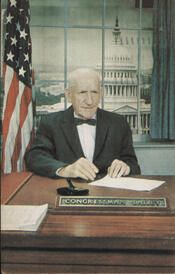
Here you will find contact information for Representative Cleveland Monroe Bailey, including email address, phone number, and mailing address.
| Name | Cleveland Monroe Bailey |
| Position | Representative |
| State | West Virginia |
| District | 3 |
| Party | Democratic |
| Status | Former Representative |
| Term Start | January 3, 1945 |
| Term End | January 3, 1963 |
| Terms Served | 8 |
| Born | July 15, 1886 |
| Gender | Male |
| Bioguide ID | B000035 |
Editorial and Source Notes
Last reviewed: January 1, 2026
We prioritize official government pages and published records. Information can change after publication.
Primary records and source links are added as they are verified.
Report a correction: see our Editorial Policy.
About Representative Cleveland Monroe Bailey
Cleveland Monroe Bailey (July 15, 1886 – July 13, 1965) was a Democratic U.S. Representative from West Virginia who served eight terms in the United States Congress between 1945 and 1963. His congressional career spanned a transformative period in American history, encompassing the end of World War II, the early Cold War, and the beginnings of the modern civil rights era, during which he represented the interests of his West Virginia constituents and contributed to the national legislative process.
Bailey was born on July 15, 1886, in West Virginia, where he spent his formative years. Growing up in a predominantly rural, resource-rich state shaped by coal mining and related industries, he was exposed early to the economic and social conditions that would later inform his public service. The challenges facing working families in Appalachia, including issues of employment, infrastructure, and education, helped frame his understanding of the role government could play in improving everyday life.
In keeping with the expectations of public figures of his generation, Bailey pursued an education that prepared him for civic engagement and leadership. His schooling in West Virginia provided the foundation for his later work in public affairs and politics. The skills and knowledge he acquired as a young man, particularly in communication and civic responsibility, would prove essential as he moved into positions of increasing responsibility and public visibility.
Before entering Congress, Bailey built a career that reflected a steady progression into public life. He became involved in local and state affairs in West Virginia, gaining familiarity with the concerns of his fellow citizens and the workings of government. Through this experience, he developed a reputation as a committed Democrat and an advocate for his community, which positioned him to seek higher office. His early career helped him cultivate relationships and an understanding of legislative processes that would later guide his work in the U.S. House of Representatives.
Bailey was first elected to the United States House of Representatives as a Democrat from West Virginia in 1944, taking office in January 1945. He would go on to serve eight terms, remaining in Congress until 1963. During these years, he participated actively in the legislative process at a time when the nation was transitioning from wartime mobilization to peacetime prosperity, confronting the challenges of the Cold War, and beginning to address civil rights and social welfare issues more directly. As a member of the House of Representatives, he worked within the committee system, debated major national policies, and consistently sought to represent the needs and priorities of his West Virginia constituents, particularly in areas related to economic development, infrastructure, and support for working families.
Bailey’s congressional service coincided with significant shifts in federal policy and the expanding role of the national government in American life. He took part in deliberations over postwar reconstruction, national defense, and domestic programs that affected education, transportation, and social services. Throughout his tenure, he remained aligned with the Democratic Party’s mid‑twentieth‑century emphasis on economic security and public investment, while also reflecting the perspectives and concerns of a largely rural, industrially oriented state. His long service in the House underscored the confidence his constituents placed in his representation over nearly two decades.
After leaving Congress in 1963, Bailey retired from elective office but remained identified with the generation of lawmakers who had helped guide the United States through the complex transition from World War II into the modern era. He spent his later years in West Virginia, maintaining ties to the communities he had long served. Cleveland Monroe Bailey died on July 13, 1965, two days before his seventy‑ninth birthday, leaving a record of extended public service as a Democratic representative of West Virginia in the United States Congress.