Representative Oliver James Dickey
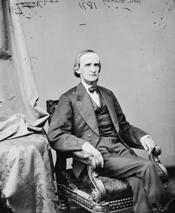
Here you will find contact information for Representative Oliver James Dickey, including email address, phone number, and mailing address.
| Name | Oliver James Dickey |
| Position | Representative |
| State | Pennsylvania |
| District | 9 |
| Party | Republican |
| Status | Former Representative |
| Term Start | March 4, 1867 |
| Term End | March 3, 1873 |
| Terms Served | 3 |
| Born | April 6, 1823 |
| Gender | Male |
| Bioguide ID | D000315 |
Editorial and Source Notes
Last reviewed: January 1, 2026
We prioritize official government pages and published records. Information can change after publication.
Primary records and source links are added as they are verified.
Report a correction: see our Editorial Policy.
About Representative Oliver James Dickey
Oliver James Dickey (April 6, 1823 – April 21, 1876) was a Republican member of the U.S. House of Representatives from Pennsylvania who served three consecutive terms in Congress from 1867 to 1873. A son of John Dickey, he emerged as a prominent lawyer, Civil War officer, and legislator during a transformative period in American history, representing the interests of his Pennsylvania constituents while contributing to the national legislative process during Reconstruction.
Dickey was born on April 6, 1823, in Old Brighton, Beaver County, Pennsylvania. He was raised in western Pennsylvania, where he received his early education before attending Beaver Academy. Seeking further academic training, he enrolled at Dickinson College in Carlisle, Pennsylvania. Although he did not complete a formal degree there, his studies provided the foundation for his subsequent legal and political career.
After his education, Dickey studied law and was admitted to the bar at Lancaster, Pennsylvania, in 1844. He established a legal practice in Lancaster, where he quickly became a respected member of the local bar. His professional reputation and engagement with public affairs led to his election as district attorney of Lancaster County, a position he held from 1856 to 1859. In this role, he was responsible for prosecuting criminal cases and advising county officials, further solidifying his standing in the community and within the emerging Republican Party.
During the American Civil War, Dickey entered military service in support of the Union. He served as lieutenant colonel of the Tenth Regiment, Pennsylvania Volunteers, a role that placed him in a position of significant responsibility for the training, discipline, and leadership of his regiment. His wartime service enhanced his public profile and aligned him with the Unionist and Republican causes that were central to Pennsylvania politics in the 1860s.
Dickey’s congressional career began in the aftermath of the Civil War, during the critical Reconstruction era. A member of the Republican Party, he was elected to the Fortieth Congress to fill the vacancy caused by the death of Representative Thaddeus Stevens, one of the most influential Radical Republicans of the period. On the same day he was chosen to complete Stevens’s unexpired term, he was also elected to the Forty-first Congress, and he was subsequently reelected to the Forty-second Congress. Thus, he served as a Representative from Pennsylvania in the United States Congress from 1867 to 1873, completing three terms in office. During these years, he participated in the legislative process at a time when Congress was grappling with the reintegration of the Southern states, the rights of formerly enslaved people, and the broader reconstruction of the Union. As a member of the House of Representatives, he took part in debates and votes that shaped national policy and represented the interests of his Pennsylvania constituents in the democratic process.
After deciding not to be a candidate for renomination in 1872, Dickey concluded his service in Congress at the end of the Forty-second Congress. He returned to Pennsylvania and resumed the practice of law in Lancaster, reestablishing himself in his former profession. In 1873, he remained active in public life as a delegate to the Pennsylvania state constitutional convention held in Harrisburg, where he contributed to the revision and modernization of the state’s fundamental law.
Oliver James Dickey continued his legal work in Lancaster until his death on April 21, 1876. He died in Lancaster, Pennsylvania, and was interred in Woodward Hill Cemetery. His career spanned law, military service, and national and state politics, marking him as a significant Pennsylvania figure in the mid-nineteenth century and a participant in the nation’s political reconstruction following the Civil War.