Representative Richard Poff
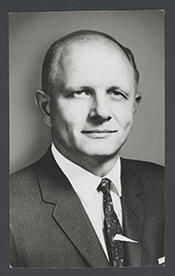
Here you will find contact information for Representative Richard Poff, including email address, phone number, and mailing address.
| Name | Richard Poff |
| Position | Representative |
| State | Virginia |
| District | 6 |
| Party | Republican |
| Status | Former Representative |
| Term Start | January 3, 1953 |
| Term End | January 3, 1972 |
| Terms Served | 10 |
| Born | October 19, 1923 |
| Gender | Male |
| Bioguide ID | P000401 |
Editorial and Source Notes
Last reviewed: February 17, 2026
We prioritize official government pages and published records. Information can change after publication.
Primary records and source links are added as they are verified.
Report a correction: see our Editorial Policy.
About Representative Richard Poff
Richard Harding “Dick” Poff (October 19, 1923 – June 27, 2011) was an American politician and judge who represented Virginia’s 6th congressional district in the United States House of Representatives from 1953 to 1973 and later served as a justice, and then senior justice, of the Supreme Court of Virginia. A Republican attorney, he was given strong consideration for appointment to the Supreme Court of the United States by President Richard M. Nixon before withdrawing from consideration, and he subsequently became one of the best-known judicial figures in his home state.
Poff was born in Radford, Montgomery County, Virginia, and attended the local public schools, graduating from Christiansburg High School. He then traveled to Salem, Virginia, to study at Roanoke College. His college education was interrupted by the Second World War, but after his military service he returned to his studies and used benefits under the GI Bill to pursue legal training. He earned a Bachelor of Laws (LL.B.) degree from the University of Virginia School of Law in Charlottesville in 1948, preparing for a career in law and public service.
During World War II, Poff served in the United States Army Air Forces as a bomber pilot with the Eighth Air Force in England. From February 1943 to August 1945 he flew thirty-five successful combat missions over Europe. For his service and valor he was awarded the Distinguished Flying Cross and was inactivated from the service with the rank of first lieutenant. His wartime experience and subsequent legal education shaped his public image as a disciplined veteran-lawyer when he entered politics in the postwar era.
After completing law school, Poff practiced law in Virginia and became active in Republican politics at a time when the state was still dominated by the Democratic Byrd Organization. In the 1952 elections he ran for Congress in Virginia’s 6th congressional district and defeated incumbent Democrat Clarence G. Burton with 51.55 percent of the vote. He was the first Republican to represent that part of Virginia since Reconstruction, a breakthrough that likely owed something to Dwight D. Eisenhower’s success in carrying the state in the presidential election that year, as well as to a long-developing tendency among Byrd Democrats in western Virginia and the Shenandoah Valley to split their tickets. Poff took office on January 3, 1953, beginning the first of ten consecutive terms in the House of Representatives.
Poff’s congressional career extended over two decades, during which he became a prominent member of the Republican minority from the South and a significant participant in the legislative process. He was reelected in 1954 with 62.31 percent of the vote against Democrat Ernest Robertson and Social Democrat J. B. Brayman; in 1956 with 62.09 percent against Democrat John L. Whitehead and Brayman; in 1958 with 56.74 percent against Democrat Richard F. Pence and Brayman; in 1960 with 82.62 percent against Brayman, then running as a Social Democrat; in 1962 with 65.22 percent against Democrat John P. Wheeler and Independent Brayman; in 1964 with 56.24 percent against Democrat William B. Hopkins; in 1966 with 80.84 percent against Democrat Murray A. Stoller; in 1968 with 92.16 percent against Democrat Tom Hufford; and in 1970 with 74.58 percent against Democrat Roy R. White. Over time he consolidated his position to the point that he never again faced a contest as close as his initial victory, and he became well liked by many constituents, including some African Americans in his district, many of whom had never before been represented by a Republican.
Poff’s record on civil rights and constitutional issues was complex and controversial. Along with Joel Broyhill and the rest of Virginia’s congressional delegation, and in common with nearly all members from Southern states, he signed the 1956 Southern Manifesto protesting the Supreme Court’s decision in Brown v. Board of Education and the mandate to desegregate public schools. Linwood Holton, who later became Virginia’s first post-Reconstruction Republican governor, suggested that Poff likely could not have been reelected had he refused to sign. Consistent with that stance, Poff voted against the Civil Rights Acts of 1957, 1960, 1964, and 1968, and against the Voting Rights Act of 1965. At the same time, he supported some measures aimed at expanding political and economic opportunity, voting in favor of the Twenty-Fourth Amendment to the Constitution, which abolished the poll tax in federal elections, and in 1971 voting for the Equal Employment Opportunity Act and supporting federal aid to accelerate the desegregation process. In a 1971 newspaper interview, when under consideration for the Supreme Court, he acknowledged that his opposition to earlier civil rights measures had been driven in part by electoral considerations and expressed regret for those positions.
Within the House, Poff developed a reputation as a serious legislator, particularly on matters of constitutional law and criminal justice. Serving on the House Judiciary Committee, he played a central role in drafting and sponsoring the Twenty-Fifth Amendment to the United States Constitution, which clarified presidential succession and procedures for dealing with presidential disability. He was also one of the principal sponsors of the Racketeer Influenced and Corrupt Organizations Act (RICO), a major federal statute aimed at combating organized crime. In the Congressional Record, Poff stated that RICO was intended to be used against organizations rather than individuals, a view that has since been largely disregarded by the Supreme Court and lower courts, which have applied the statute more broadly. In economic policy, he sometimes diverged from his party’s leadership; he was, for example, the only member of the House Republican leadership who did not support President Eisenhower’s proposal to increase the minimum wage and expand its coverage.
Poff’s prominence in Congress led President Richard M. Nixon to consider him for a seat on the Supreme Court of the United States in 1971. Before a formal nomination was sent to the Senate, however, Poff withdrew from consideration. According to John Dean, Poff made this decision out of concern that the confirmation process would force him to reveal to his then twelve‑year‑old son that the boy had been adopted, a disclosure he feared would be emotionally harmful at that age. Despite his withdrawal, the fact of the adoption was soon reported in a column by journalist Jack Anderson, compelling Poff to inform his son anyway. By that time it was too late for his candidacy to be revived, and another Virginian, Lewis F. Powell Jr., was ultimately nominated and confirmed to the Court in his place.
In 1972, within a year of his public reflections on his civil rights record and his Supreme Court consideration, Poff resigned from the House of Representatives to accept appointment as a justice of the Supreme Court of Virginia. He brought to the state’s highest court nearly two decades of federal legislative experience and a background in constitutional law. Poff later assumed senior justice status on the court, continuing to hear cases and contribute to the development of Virginia jurisprudence until his retirement. His judicial service further cemented his reputation as a thoughtful, if sometimes controversial, public figure who had moved from the legislative to the judicial branch while remaining influential in Virginia public life.
In his personal life, Poff married Jo Ann Topper in 1948, shortly after completing law school. The couple had three children and remained married until her death in 1978. In 1980 he married his second wife, Jean Murphy, with whom he remained until her death in 2007. Richard Harding Poff died on June 27, 2011, at a life care center in Tullahoma, Tennessee. His legacy in Virginia is reflected in the naming of the Richard H. Poff Federal Building in Roanoke, which houses many of the primary federal offices in southwest Virginia, including the United States District Court for the Western District of Virginia and the Department of Veterans Affairs. The Roanoke Public Library maintains a collection of newsletters that Congressman Poff sent to his constituents between 1954 and 1971, preserving a record of his communication with the district he represented for twenty years.