Representative Samuel Ryan Curtis
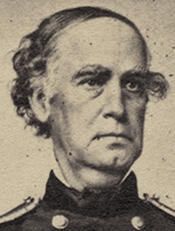
Here you will find contact information for Representative Samuel Ryan Curtis, including email address, phone number, and mailing address.
| Name | Samuel Ryan Curtis |
| Position | Representative |
| State | Iowa |
| District | 1 |
| Party | Republican |
| Status | Former Representative |
| Term Start | December 7, 1857 |
| Term End | March 3, 1863 |
| Terms Served | 3 |
| Born | February 3, 1805 |
| Gender | Male |
| Bioguide ID | C001013 |
Editorial and Source Notes
Last reviewed: January 1, 2026
We prioritize official government pages and published records. Information can change after publication.
Primary records and source links are added as they are verified.
Report a correction: see our Editorial Policy.
About Representative Samuel Ryan Curtis
Samuel Ryan Curtis (February 3, 1805 – December 26, 1866) was an American military officer, civil engineer, and politician who became one of the first Republicans elected to Congress and later a prominent Union Army general in the Trans-Mississippi Theater of the American Civil War. He is particularly remembered for his leadership and victories at the Battle of Pea Ridge in 1862 and the Battle of Westport in 1864, actions that helped secure Union control in key regions west of the Mississippi River. A member of the Republican Party, he represented Iowa in the United States House of Representatives from 1857 until his resignation in 1861, serving three terms during a critical period leading up to and including the early months of the Civil War.
Curtis was born on February 3, 1805, near Champlain in Clinton County, New York. Little is recorded in these sources about his early childhood, but he came of age in the early national period, when the United States was expanding westward and professional military and engineering training were increasingly valued. He secured an appointment to the United States Military Academy at West Point, where he received the formal military and engineering education that would shape both his early Army service and later civilian career. Graduating into a small but professional officer corps, he entered the U.S. Army at a time of relative peace but growing national ambition.
Following his graduation from West Point, Curtis served as an officer in the United States Army, gaining experience that combined military command with engineering responsibilities. After leaving regular Army service, he pursued a civilian career as an engineer and became involved in infrastructure and development projects in the growing West and Midwest. His technical training and organizational skills made him a valuable figure in local and regional affairs, and he eventually settled in Iowa, where he emerged as a civic leader. As the sectional crisis over slavery intensified in the 1850s, Curtis aligned himself with the newly formed Republican Party, which opposed the expansion of slavery into the western territories.
Curtis was elected as a Republican to the United States House of Representatives from Iowa and served from 1857 to 1863, though his active service in Congress ended earlier with his resignation to reenter military service. His tenure encompassed the Thirty-fifth, Thirty-sixth, and part of the Thirty-seventh Congresses, a period marked by escalating tensions between North and South, the secession crisis, and the outbreak of the Civil War. As one of the first Republicans elected to Congress, he contributed to the legislative process during three terms in office and represented the interests of his Iowa constituents during a time of profound national upheaval. A supporter of Abraham Lincoln, Curtis was regarded highly enough that he was considered for a cabinet position in the Lincoln administration. However, the onset of war redirected his path back to the field, and on June 1, 1861, he was appointed colonel of the 2nd Iowa Infantry. This appointment led him to resign his congressional seat on August 4, 1861, in order to devote himself fully to military service.
Curtis’s Civil War career advanced rapidly. He was promoted to brigadier general of volunteers, with the promotion backdated to May 17, 1861, reflecting the confidence Union authorities placed in his abilities. After helping to organize and stabilize the volatile situation in St. Louis, Missouri, he was given command of the Army of the Southwest on December 25, 1861, by Major General Henry W. Halleck. The Army initially comprised three divisions, commanded by Brigadier General Franz Sigel, Brigadier General Alexander Asboth, and Colonel Jefferson C. Davis. When Sigel, a German-born officer with strong influence among German immigrant troops, threatened to resign because he had not been given overall command, Curtis resolved the crisis by granting Sigel command of the first two divisions, largely composed of German immigrants, and creating a new Fourth Division under Colonel Eugene A. Carr. Curtis moved his headquarters south to Rolla, Missouri, as he sought to secure Union control in Missouri and Arkansas.
In March 1862, Curtis led his forces into northwest Arkansas and achieved a major Union victory at the Battle of Pea Ridge. This battle was crucial in maintaining Union dominance in Missouri and disrupting Confederate efforts in the Trans-Mississippi region. The aftermath of the fighting left a deep impression on him; reflecting on the devastation, he wrote, “The scene is silent and sad. The vulture and the wolf now have the dominion and the dead friends and foes sleep in the same lonely graves.” For his success at Pea Ridge, he was promoted to major general of volunteers, effective March 21, 1862. The news of his promotion coincided with personal tragedy: on the same day he learned of this advancement, he also received word that his twenty-year-old daughter, Sadie, had died of typhoid fever in St. Louis. After Pea Ridge, Curtis’s army moved eastward into northeast Arkansas, capturing Helena, Arkansas, in July 1862, thereby securing another important foothold for Union operations along the Mississippi and in the interior South.
Later in 1862, Curtis was assigned to broader administrative and operational responsibilities. In September he was given command of the District of Missouri, a post that placed him at the center of complex military, political, and social conflicts in a border state deeply divided by the war. His strong abolitionist views, however, brought him into conflict with Missouri’s Unionist but more conservative state leadership, including the governor. The resulting political friction led President Lincoln to reassign him from the District of Missouri to command the Department of Kansas and Indian Territory, where he oversaw Union operations in a vast and often lawless frontier region. The war also struck Curtis’s family directly. In October 1863, his son, Major Henry Zarah Curtis, serving as adjutant to Brigadier General James G. Blunt, was killed in a surprise attack by William Quantrill’s guerrillas at the Battle of Baxter Springs. Quantrill’s men, wearing Federal uniforms and giving no quarter, inflicted heavy casualties in the raid. In memory of his son, Curtis later gave the name Fort Zarah to a military post.
In 1864, Curtis returned to a central role in the defense of Missouri when Confederate Major General Sterling Price launched a large-scale raid into the state. Curtis gathered the forces of his department, including several regiments of Kansas State Militia, and organized them as the Army of the Border. With this improvised but determined force, he confronted Price’s invading column and brought it to battle near Kansas City. On October 23, 1864, Curtis’s troops defeated Price at the Battle of Westport, often called the “Gettysburg of the West,” effectively ending major Confederate offensive operations in the Trans-Mississippi region. Following this campaign, Curtis was reassigned to a very different theater of operations as commander of the Department of the Northwest. In that capacity, he oversaw the closing phase of the Army’s response to uprisings by Native Americans in southern Minnesota and Dakota Territory, conflicts rooted in broken treaties, settler encroachment, and deep grievances among the Dakota and other Indigenous peoples.
After the Civil War, Curtis’s active military responsibilities diminished as the nation transitioned from war to peace and Reconstruction. His long career had spanned early service as a professional soldier and engineer, three terms in the U.S. House of Representatives representing Iowa from 1857 to 1863, and prominent wartime commands that shaped the outcome of the conflict west of the Mississippi River. He remained a respected figure in Iowa and in national military circles. Curtis died on December 26, 1866, closing a life that had been closely intertwined with the expansion, crisis, and preservation of the United States. His former residence, the Gen. Samuel R. Curtis House in Iowa, has been listed on the National Register of Historic Places, and his papers are preserved in collections such as the Samuel Ryan Curtis Papers in the Yale Collection of Western Americana at the Beinecke Rare Book and Manuscript Library, ensuring that his contributions as a legislator, engineer, and Union general remain accessible to historians and the public.