Representative Santiago Iglesias
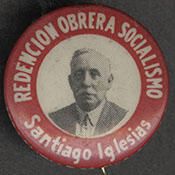
Here you will find contact information for Representative Santiago Iglesias, including email address, phone number, and mailing address.
| Name | Santiago Iglesias |
| Position | Representative |
| State | Puerto Rico |
| District | At-Large |
| Party | Coalitionist |
| Status | Former Representative |
| Term Start | March 9, 1933 |
| Term End | January 3, 1941 |
| Terms Served | 4 |
| Born | February 22, 1872 |
| Gender | Male |
| Bioguide ID | I000002 |
Editorial and Source Notes
Last reviewed: January 1, 2026
We prioritize official government pages and published records. Information can change after publication.
Primary records and source links are added as they are verified.
Report a correction: see our Editorial Policy.
About Representative Santiago Iglesias
Santiago Iglesias Pantín (February 22, 1872 – December 5, 1939) was a Puerto Rican socialist leader, trade union organizer, and politician who served as Resident Commissioner of Puerto Rico in the United States Congress from March 4, 1933, until his death in 1939. A member of the Coalitionist Party, he represented Puerto Rico in the 73rd, 74th, 75th, and 76th Congresses and was a prominent advocate of statehood for Puerto Rico, labor rights, and social reform during a critical period in American and Puerto Rican history.
Iglesias was born in A Coruña, Galicia, Spain, where he attended the common schools and was apprenticed as a cabinet maker. As a young man he stowed away on a ship that took him to Cuba, where he became involved in the labor movement. Beginning in 1889, he served as secretary of the Workingmen Trades Circle in Havana, organizing workers and gaining experience as a trade union activist. His early exposure to labor struggles in Cuba shaped his lifelong commitment to workers’ rights and social justice.
Iglesias later moved to Puerto Rico, where he emerged as one of the island’s leading labor organizers and socialist figures. He founded and edited several influential labor newspapers, including Porvenir Social, published from 1898 to 1900, Unión Obrera, published from 1903 to 1906, and Justicia, published from 1914 to 1925. Through these publications and his organizing work, he helped build a modern labor movement in Puerto Rico. His activities frequently brought him into conflict with authorities, and he was often arrested and jailed for his union and socialist organizing. He developed a close relationship with American Federation of Labor (AFL) president Samuel Gompers, who in 1901 appointed him general organizer of the AFL for the districts of Puerto Rico and Cuba. In 1915, Iglesias founded Puerto Rico’s Socialist Party, a pro-labor, pro-alliance party that became a central vehicle for working-class political participation on the island. From 1925 to 1933 he also served as secretary of the Pan-American Federation of Labor, extending his influence throughout the hemisphere.
In addition to his labor activities, Iglesias built a substantial political career in Puerto Rico before entering the U.S. Congress. He first sought federal office in 1908, when he ran unsuccessfully against Tulio Larrínaga for Puerto Rico’s non-voting delegate seat in the United States Congress. Following the establishment of the civil government under the Jones-Shafroth Act, he was elected to the first Senate of Puerto Rico in 1917. He was reelected several times and served in the Senate continuously until his election as Resident Commissioner in 1932. In the insular legislature he pressed for social and labor reforms, many of which, though not enacted in his lifetime, later became law as part of the Popular Democratic Party’s reform agenda in the 1940s or were incorporated into the Constitution of Puerto Rico in 1952. Among his priorities was legislation to allow Puerto Ricans to elect their own governor, a measure he strongly supported but which did not become law until 1947.
Iglesias was elected as a Coalitionist Resident Commissioner on November 8, 1932, and took office on March 4, 1933, at the outset of the New Deal era. He was reelected in 1936 for the term ending January 3, 1941, and served continuously until his death in 1939. As Resident Commissioner, he participated in the legislative process in the U.S. House of Representatives, representing the interests of his Puerto Rican constituents during a period of profound economic and political change. In Congress, he served on the Committees on Insular Affairs, Agriculture, and Labor, assignments that aligned closely with his longstanding concerns for colonial policy, rural development, and workers’ rights. He worked to secure the inclusion of Puerto Rico in many New Deal assistance programs, including road construction projects, and he was instrumental in extending the benefits of the Bankhead–Jones Act to the island, thereby enabling agricultural experimentation and rural improvement. He also supported federal initiatives to combat malaria in Puerto Rico and advocated changes to the Jones Act’s provisions on shipping, including an exclusion regarding the taxation of shipping between Puerto Rico and other U.S. ports. Throughout his congressional service he remained a vocal supporter of statehood for Puerto Rico and continued to push, though unsuccessfully, for greater self-government, including the popular election of the island’s governor.
Iglesias’s political work made him a target of extremist opposition. In 1936 he was wounded in an assassination attempt by partisans of the Puerto Rican Nationalist Party, reflecting the intense ideological and political conflicts on the island during the 1930s. Despite the attack, he continued his congressional duties and advocacy for labor and political reform. His tenure in Congress coincided with a significant period in American history, and he used his position to ensure that Puerto Rico was not overlooked in federal policymaking, particularly in matters affecting workers, agriculture, infrastructure, and public health.
In his personal life, Iglesias married Justa Pastora Bocanegra in 1902. The couple had a large family, and he expressed his political ideals through the names of his children. Their daughters were named Josefina Victoria, Libertad, Fraternidad, America, Igualdad, Justicia, Laura Paz, and Luz, reflecting themes of liberty, equality, justice, and peace. They also had three sons, including Edward Iglesias, a career military officer; Manuel Francisco Iglesias, a distinguished U.S. Air Force captain and lead crew radar officer on B-29s during World War II; and Santiago Ángel. His family later established the Iglesias Family Foundation, a nonprofit charitable organization dedicated to preserving and promoting his legacy.
Santiago Iglesias died in office in Washington, D.C., on December 5, 1939, while serving in the 76th Congress. His body was returned to Puerto Rico, where it lay in state at the Capitol. Contemporary accounts reported that some 200,000 people filed past his casket and that approximately 50,000 mourners filled and gridlocked the streets of Old San Juan during his funeral, a testament to his stature as a labor and political leader. He was interred at Santa María Magdalena de Pazzis Cemetery in San Juan, Puerto Rico. In early 1943, a Liberty ship was named in his honor, further commemorating his contributions. Iglesias is remembered as a central figure in the creation of the modern labor movement in Puerto Rico, a pioneering socialist politician, and one of the most influential Puerto Rican representatives to serve in the United States Congress.