Representative Timothy J. Penny
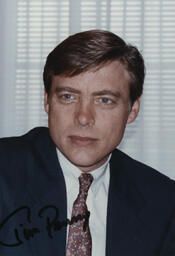
Here you will find contact information for Representative Timothy J. Penny, including email address, phone number, and mailing address.
| Name | Timothy J. Penny |
| Position | Representative |
| State | Minnesota |
| District | 1 |
| Party | Democratic |
| Status | Former Representative |
| Term Start | January 3, 1983 |
| Term End | January 3, 1995 |
| Terms Served | 6 |
| Born | November 19, 1951 |
| Gender | Male |
| Bioguide ID | P000215 |
Editorial and Source Notes
Last reviewed: February 17, 2026
We prioritize official government pages and published records. Information can change after publication.
Primary records and source links are added as they are verified.
Report a correction: see our Editorial Policy.
About Representative Timothy J. Penny
Timothy Joseph Penny (born November 19, 1951) is an American author, musician, and former politician from Minnesota who served as a Representative from Minnesota in the United States Congress from 1983 to 1995. A member of the Minnesota Democratic–Farmer–Labor Party (DFL), he represented Minnesota’s 1st congressional district in the U.S. House of Representatives for six consecutive terms, contributing to the legislative process during a significant period in American history. In 2002 he was the Independence Party of Minnesota’s nominee for governor, presenting himself as a centrist alternative in that year’s three-way gubernatorial contest.
Penny was born in Albert Lea, Freeborn County, Minnesota, and grew up in southern Minnesota. He attended Winona State College (now Winona State University), where he studied political science and received a bachelor’s degree in 1974. In addition to his academic training, Penny served in the United States Naval Reserve, in which he was commissioned a lieutenant commander, combining military service with the early stages of his political career.
Penny entered elective office at a relatively young age. He was elected to the Minnesota Senate in 1976 and served there from 1976 to 1982. During his tenure in the state legislature, he represented a largely rural constituency in southern Minnesota, gaining experience in state-level policymaking and building a reputation as a pragmatic Democrat attuned to the concerns of his district. His work in the Minnesota Senate laid the groundwork for his subsequent campaign for Congress.
In 1982, following redistricting that reshaped southern Minnesota’s congressional boundaries, Penny sought and won the DFL nomination for the newly configured 1st District. In the general election he defeated four-term Republican Representative Tom Hagedorn, who had represented the old 2nd District, becoming only the third Democrat ever to represent this area in Congress. The race was influenced by divisions within the Republican Party after the conservative Hagedorn narrowly defeated two-term First District moderate incumbent Arlen Erdahl for the GOP endorsement, as well as by a broader national trend of Democratic gains in congressional elections that year. Penny was reelected in 1984 with 56 percent of the vote, becoming the first non-Republican to win reelection in the district since Minnesota achieved statehood. He went on to win four additional terms by an average of about 70 percent of the vote, never again facing a contest as close as his initial victory.
During his six terms in the U.S. House of Representatives, from January 3, 1983, to January 3, 1995, Penny participated actively in the democratic process and represented the interests of his largely rural southern Minnesota constituents. A member of the Democratic Party and its state affiliate, the DFL, he was generally regarded as a somewhat conservative Democrat, opposing gun control and abortion during much of his congressional career—positions that were typical for his district at the time—though he later became pro-choice. He was best known for his work on fiscal policy and budget issues, developing a reputation as a deficit hawk and aligning himself with efforts to restrain federal spending and promote long-term fiscal responsibility. Despite having built a strong political base and what was widely seen as a nearly unbreakable hold on his district, Penny announced in 1994 that he would not seek a seventh term, and he left Congress at the conclusion of his sixth term in 1995.
After leaving Congress, Penny pursued a career as an author, commentator, and policy advocate. He co-authored several books on politics and public policy, including Common Cents: A Retiring Six-Term Congressman Reveals How Congress Really Works — And What We Must Do to Fix It (1995), Payment Due (1996), and The 15 Biggest Lies in Politics (1998). He was the lead author of “The Road to Generational Equity,” a manifesto on long-term fiscal reform that political analyst John Avlon has characterized as an expression of “radical centrist” thought. Following the election of Jesse Ventura as governor of Minnesota in 1998, Penny served in an informal advisory role to the governor and assisted with Ventura’s gubernatorial transition team, further cementing his association with centrist and reform-oriented politics.
In 2002, with Governor Ventura choosing not to seek reelection, Penny joined the Independence Party of Minnesota in July and sought the governorship as that party’s nominee. Running on a “sensible center” platform, he selected State Senator Martha Robertson of Minnetonka, a moderate Republican, as his running mate. Polls in October 2002 showed a near three-way tie among Penny, DFL nominee Roger Moe, and Republican nominee Tim Pawlenty. In the general election, however, Penny finished third with 16 percent of the vote, behind Pawlenty, who won with 44 percent, and Moe, who received 36 percent; Green Party candidate Ken Pentel received about 2 percent. Penny remained active in public affairs thereafter, and in 2008 he endorsed Republican John McCain for president and Independence Party candidate and former U.S. Senator Dean Barkley for the U.S. Senate from Minnesota.
In later years, Penny has held a variety of leadership and advisory positions in civic and policy organizations. He serves as president of the Southern Minnesota Initiative Foundation, a regional philanthropic organization focused on economic and community development. He has been a senior fellow at the University of Minnesota’s Hubert H. Humphrey Institute of Public Affairs (now the Humphrey School of Public Affairs), where he at one time served as co-director alongside his former Republican congressional colleague Vin Weber. Penny serves on the advisory board of the Institute for Law and Politics at the University of Minnesota Law School and sits on the board of directors of Energy Literacy Advocates. He is vice chairman of the board of directors of ACDI/VOCA, a U.S.-based international development nonprofit organization, and is a co-chair of the Committee for a Responsible Federal Budget, reflecting his long-standing interest in fiscal policy and budget reform.
Penny resides in Owatonna, Minnesota, and is the father of four adult children. In addition to his political and policy work, he is active as a musician and is the lead singer and guitarist in a band called Led Penny. Alongside his authorship of books and policy manifestos, his musical pursuits and ongoing involvement in nonprofit leadership and academic advisory roles underscore the breadth of his activities following his twelve years of service in the United States House of Representatives.