Representative Warren Worth Bailey
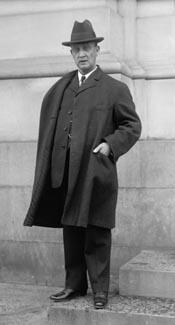
Here you will find contact information for Representative Warren Worth Bailey, including email address, phone number, and mailing address.
| Name | Warren Worth Bailey |
| Position | Representative |
| State | Pennsylvania |
| District | 19 |
| Party | Democratic |
| Status | Former Representative |
| Term Start | April 7, 1913 |
| Term End | March 3, 1917 |
| Terms Served | 2 |
| Born | January 8, 1855 |
| Gender | Male |
| Bioguide ID | B000050 |
Editorial and Source Notes
Last reviewed: January 1, 2026
We prioritize official government pages and published records. Information can change after publication.
Primary records and source links are added as they are verified.
Report a correction: see our Editorial Policy.
About Representative Warren Worth Bailey
Warren Worth Bailey (January 8, 1855 – November 9, 1928) was a Democratic member of the U.S. House of Representatives from Pennsylvania, a Georgist publisher, and an influential advocate of single-tax principles. He served as a Representative from Pennsylvania in the United States Congress from 1913 to 1917, completing two terms in office. A member of the Democratic Party, he contributed to the legislative process during a significant period in American history, and he and other Georgists played a leading role in framing the U.S. income tax law of 1916, which exempted most labor income and targeted land rent.
Bailey was born in New Winchester, Hendricks County, Indiana, on January 8, 1855. In 1863 he moved with his parents to Illinois, settling in Edgar County. He attended the local country schools, receiving a basic formal education typical of rural Midwestern communities of the period. As a young man he worked as a telegrapher until 1875, gaining early experience in communications and the rapidly expanding railroad and telegraph networks that were transforming the American economy.
Bailey’s career in journalism and publishing began in the 1870s. He joined the Kansas News in Kansas, Illinois, where he learned the printing trade and entered the newspaper business. In 1877 he and his brother engaged in publishing at Carlisle, Indiana, and subsequently purchased the Vincennes News, which they published until 1887. That year Bailey moved to Chicago, Illinois, where he became a member of the staff of the Chicago Daily News and later worked for the Evening Mail. These positions placed him within the vigorous urban press of the late nineteenth century and provided a platform for his developing political and economic views.
In 1893 Bailey moved to Johnstown, Pennsylvania, where he published the Johnstown Democrat, a newspaper devoted to the single-tax principle associated with the ideas of Henry George. As a Georgist publisher, he used the paper to advocate for tax reforms that would shift the burden away from labor and productive enterprise and toward land values and economic rent. His prominence in this movement later informed his role in national debates over taxation policy. Bailey first sought federal office as a Democrat in 1906 but was an unsuccessful candidate for election that year. He remained active in party affairs and served as a delegate at large to the 1912 Democratic National Convention in Baltimore, which nominated Woodrow Wilson for the presidency.
Bailey was elected as a Democrat from Pennsylvania to the Sixty-third and Sixty-fourth Congresses, serving from March 4, 1913, to March 3, 1917. His service in Congress occurred during a significant period in American history marked by the Progressive Era reforms and the lead-up to U.S. involvement in World War I. As a member of the House of Representatives, Warren Worth Bailey participated in the democratic process and represented the interests of his Pennsylvania constituents while advancing his Georgist economic views. He was chairman of the United States House Committee on Mileage during the Sixty-third Congress and chairman of the United States House Committee on Expenditures in the Department of Justice during the Sixty-fourth Congress. In collaboration with other Georgists and reformers, he helped lead in framing the U.S. income tax law of 1916, which was designed to exempt most labor income and to target land rent, reflecting his long-standing commitment to single-tax principles.
Bailey was an unsuccessful candidate for reelection to the House in 1916. He continued to seek a return to Congress and ran again as a Democrat in 1920, 1922, and 1926, but was unsuccessful in each of those campaigns. He also unsuccessfully contested the election of Anderson Howell Walters to the Sixty-ninth Congress, underscoring his persistent engagement in electoral politics even after leaving office. Despite these defeats, he remained a notable figure in Pennsylvania Democratic circles and among advocates of tax reform.
After his congressional service, Bailey resumed his journalistic career in Johnstown, Pennsylvania. He continued to be identified with Georgist thought and the single-tax movement, using his newspaper work to promote economic reforms consistent with the principles he had advanced in Congress. He lived in Johnstown for the remainder of his life, remaining active in public discourse through his writing and editorial work.
Warren Worth Bailey died in Johnstown, Cambria County, Pennsylvania, on November 9, 1928. He was interred in Grandview Cemetery in Johnstown. His papers, reflecting his dual career in journalism and politics and his role in the Georgist movement and federal tax policy, are preserved in archival collections, including the Warren Worth Bailey Papers at the Seeley G. Mudd Manuscript Library at Princeton University.