Representative William Patterson Borland
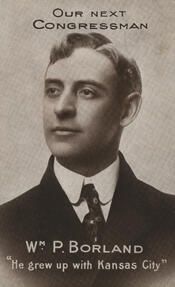
Here you will find contact information for Representative William Patterson Borland, including email address, phone number, and mailing address.
| Name | William Patterson Borland |
| Position | Representative |
| State | Missouri |
| District | 5 |
| Party | Democratic |
| Status | Former Representative |
| Term Start | March 15, 1909 |
| Term End | March 3, 1919 |
| Terms Served | 5 |
| Born | October 14, 1867 |
| Gender | Male |
| Bioguide ID | B000643 |
Editorial and Source Notes
Last reviewed: January 1, 2026
We prioritize official government pages and published records. Information can change after publication.
Primary records and source links are added as they are verified.
Report a correction: see our Editorial Policy.
About Representative William Patterson Borland
William Patterson Borland (October 14, 1867 – February 20, 1919) was a Democratic U.S. Representative from Missouri who served in the United States Congress from 1909 to 1919. He was born on October 14, 1867, in Leavenworth, Kansas, where he attended the public schools. After completing his early education, he pursued legal studies and enrolled in the law department of the University of Michigan, from which he graduated in 1892. That same year he was admitted to the bar, beginning a professional career that would combine law, education, and public service.
Following his admission to the bar, Borland commenced the practice of law in Kansas City, Missouri. He quickly became a prominent figure in the city’s legal and civic life. Demonstrating a strong interest in legal education, he assisted in the organization of the Kansas City School of Law and served as its dean from 1895 through 1909. In this capacity, he helped shape the training of a generation of lawyers in Missouri. In 1898 he further contributed to local governance as a member of the board of freeholders directed to draft a charter for Kansas City, participating in the formulation of the city’s fundamental governing document. In addition to his work as a practitioner and educator, he engaged as an author on law subjects, adding to the professional literature of his field.
Borland’s growing reputation in law and civic affairs provided the foundation for his entry into national politics. A member of the Democratic Party, he was elected as a Democrat to the Sixty-first and four succeeding Congresses, serving five consecutive terms in the U.S. House of Representatives from March 4, 1909, until his death on February 20, 1919. During this decade-long tenure, he represented the interests of his Missouri constituents and contributed to the legislative process during a significant period in American history, which encompassed the Progressive Era and the First World War. His service in Congress placed him at the center of debates over domestic reform, urban development, and national preparedness.
In Congress, Borland became particularly associated with several notable legislative initiatives. In 1914 he sponsored the District of Columbia Improvements Legislation, informally known as the Borland Amendment, which addressed matters of public works and governance in the nation’s capital. He also joined with Senator William M. Calder in introducing the Calder–Borland Bill, later known as the Standard Time Act, which established standard time zones and proposed daylight saving time for workers in the country, reflecting contemporary concerns about efficiency and wartime resource conservation. An advocate for prohibition, Borland aligned himself with the growing national movement to restrict and ultimately ban the manufacture and sale of alcoholic beverages. In matters of national defense, he supported the Kahn amendment, a measure backing military preparedness prior to the formal involvement of the United States in World War I, and later voted in favor of the Selective Service Act of 1917, which instituted conscription to raise a national army. Despite his active legislative record, he was an unsuccessful candidate for renomination in 1918 to the Sixty-sixth Congress, losing the Democratic primary to William T. Bland.
In his personal life, Borland married Ona Winants in 1904. While his public career kept him deeply engaged in the legal and political life of Kansas City and the nation, he also maintained connections with civic and fraternal organizations, including the Masonic order, which would play a role in the circumstances of his death. His life during these years reflected the commitments of a professional man of the Progressive Era, balancing family, public service, and organizational involvement.
In October 1918, during the global influenza pandemic, Borland was stricken with the Spanish flu. Although he recovered sufficiently to travel, his health remained compromised. While on a Masonic mission abroad near Koblenz, Germany, he contracted pneumonia and died there on February 20, 1919, while still a sitting member of the House of Representatives. His death placed him among the members of the United States Congress who died in office in the first half of the twentieth century. Borland was interred in Elmwood Cemetery in Kansas City, Missouri, closing a career that had spanned law practice, legal education, municipal charter drafting, and a decade of congressional service during a transformative era in American history.