Representative William Bunn Shattuc
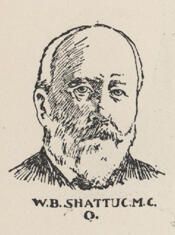
Here you will find contact information for Representative William Bunn Shattuc, including email address, phone number, and mailing address.
| Name | William Bunn Shattuc |
| Position | Representative |
| State | Ohio |
| District | 1 |
| Party | Republican |
| Status | Former Representative |
| Term Start | March 15, 1897 |
| Term End | March 3, 1903 |
| Terms Served | 3 |
| Born | June 11, 1841 |
| Gender | Male |
| Bioguide ID | S000300 |
Editorial and Source Notes
Last reviewed: January 1, 2026
We prioritize official government pages and published records. Information can change after publication.
Primary records and source links are added as they are verified.
Report a correction: see our Editorial Policy.
About Representative William Bunn Shattuc
William Bunn Shattuc (June 11, 1841 – July 13, 1911) was a United States Representative from Ohio who served three consecutive terms in the U.S. House of Representatives from 1897 to 1903. A member of the Republican Party, he represented his constituents during a significant period in American history at the turn of the twentieth century and contributed to the legislative process over the course of his service in Congress.
Born on June 11, 1841, Shattuc came of age in the decades preceding the Civil War, a time of growing sectional tension and rapid national change. Although detailed records of his early childhood and family background are limited in the surviving public sources, his later public career suggests an upbringing that prepared him for engagement in civic affairs and national politics. His formative years would have been shaped by the political debates of the 1850s and the onset of the Civil War, experiences that influenced many of his generation who later entered public service.
Information regarding Shattuc’s formal education is sparse in the available historical record, but like many nineteenth-century political figures, he likely combined schooling with early work experience and self-education. The era’s common pattern for future officeholders included study of current events, law, and public questions through reading and participation in local civic life. Whatever the precise course of his studies, Shattuc developed the knowledge and skills that enabled him to navigate the increasingly complex issues facing the nation by the late nineteenth century.
Before his election to Congress, Shattuc established himself sufficiently in his community and party to become a viable candidate for national office. His rise within the Republican Party in Ohio reflected both the party’s dominance in the state after the Civil War and his own ability to represent local interests within a broader national framework. By the 1890s, Ohio was a key state in national politics, and Republican leaders from the state played prominent roles in shaping federal policy. Shattuc’s selection as the party’s nominee for Congress indicates the confidence local Republicans placed in his judgment and leadership.
Shattuc was elected as a Republican to the U.S. House of Representatives and served three terms from 1897 to 1903. His tenure in Congress coincided with the Fifty-fifth, Fifty-sixth, and Fifty-seventh Congresses, a period marked by the Spanish–American War, the emergence of the United States as an imperial power, and ongoing debates over tariffs, currency, and industrial regulation. As a member of the House of Representatives, William Bunn Shattuc participated in the democratic process and represented the interests of his Ohio constituents while contributing to the legislative deliberations of this transformative era. During these years, Congress addressed questions of overseas territories, veterans’ issues, and domestic economic policy, and Shattuc took part in the consideration and passage of measures that reflected the priorities of his district and party.
Throughout his congressional service, Shattuc remained aligned with the Republican Party’s general positions on economic development, support for American industry, and a strong national government. Representing an Ohio constituency in a rapidly industrializing region, he would have been attentive to the concerns of manufacturers, workers, and farmers affected by national policy. His three consecutive terms attest to the continued support he enjoyed among voters, who returned him to office as national issues evolved from post–Civil War reconstruction and monetary debates toward questions of America’s role on the world stage.
After leaving Congress in 1903, Shattuc returned to private life in Ohio. Although specific details of his post-congressional activities are not extensively documented in the brief surviving summaries, former members of his era commonly remained engaged in local affairs, party politics, business, or veterans’ and civic organizations. He lived to see the first decade of the twentieth century, a time when many of the policies debated during his congressional service continued to shape the nation’s trajectory.
William Bunn Shattuc died on July 13, 1911. His career as a three-term Republican representative from Ohio placed him among the cohort of late nineteenth-century lawmakers who guided the United States through a period of rapid economic growth, overseas conflict, and political realignment. Through his service in the House of Representatives from 1897 to 1903, he played a role in the legislative processes that helped define the country’s transition into the modern era.